
BEYOND SNIFFING
Scent Detection: The Human End of the Leash
In the dog sport of scent detection, a partnership between handler and dog is a delicate balance. Leash handling is a skill, and mastering this skill isn’t easy. It goes beyond just holding on to a leash and watching your dog in a search area.
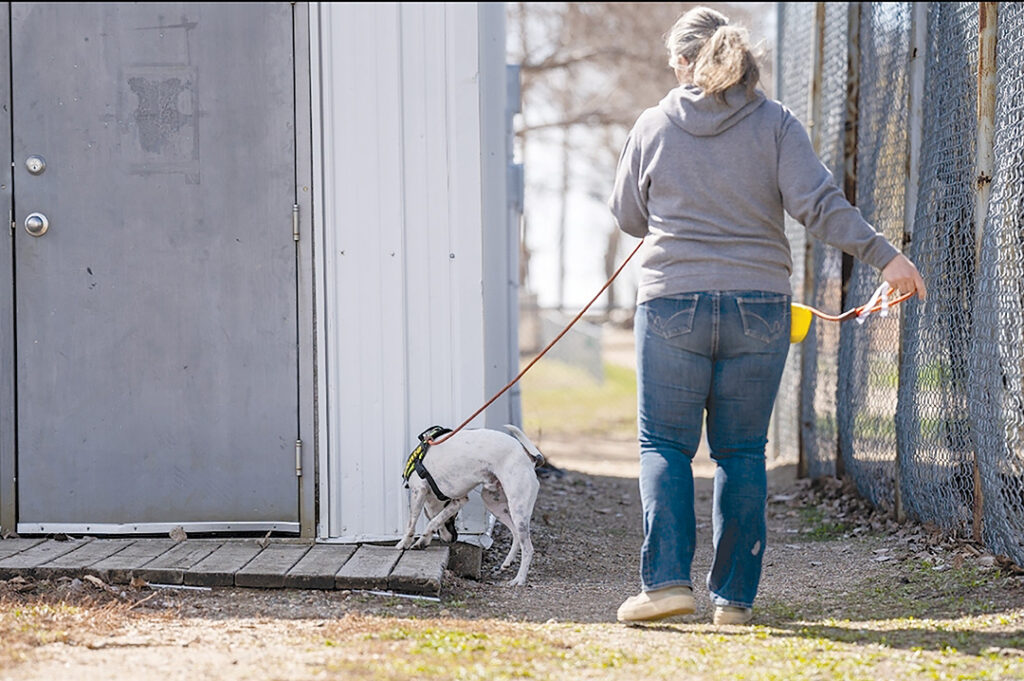
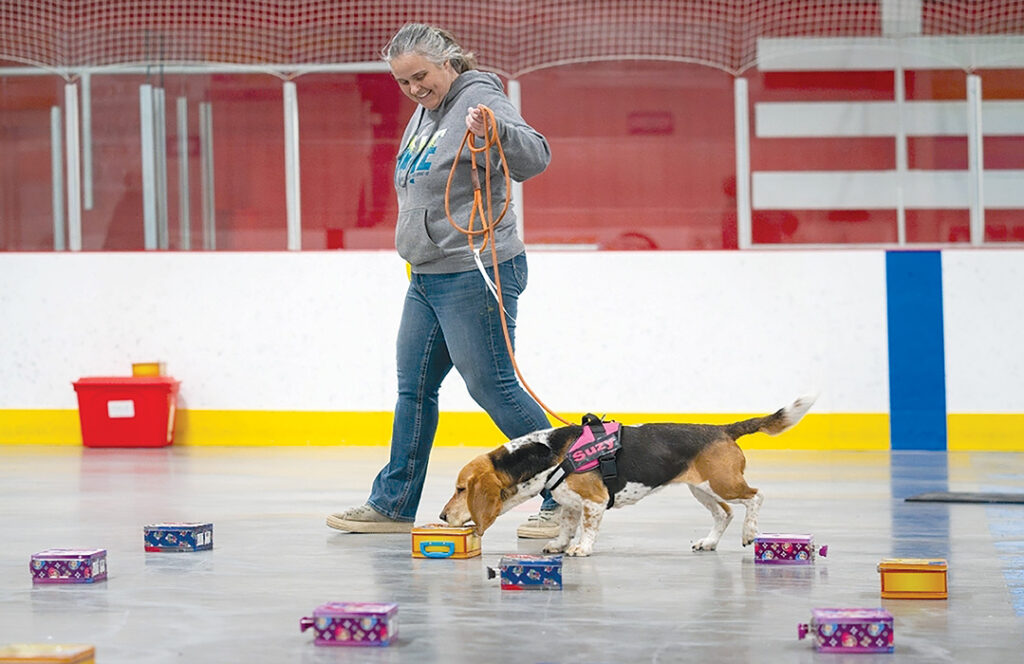
In scent work, the handler has to make sure the leash doesn’t tighten, drag, or tangle between the dog’s legs or objects in the search area. Along with leash handling skills, the handler should strive to stay out of the dog’s way, be able to collect and release the leash and lift and lower the leash based on the dog’s behaviour in the search area. The ideal picture is to have the dog work on the leash as if there is no leash attached at all.
When a dog goes into a room to find odour they do not think about what their leash is doing, how their leash could potentially restrict them, or how their leash will get in the way when searching for odour. That is our job as the handler. The dog will dart, turn, slow down, speed up, go under and potentially over things to get to the source. We have to be quick on our feet, with our hands and maneuvering the leash to allow the dog to do their part of the job.
A leash that tightens while the dog is searching preventing them from moving forward to the source of the odour could easily take the dog out of sourcing and can discourage continued movement to the source. A leash that gets tangled in an object or between your dog’s legs because it is dragging in a search area means stopping the search, your dog and your team lose focus, and you need to reset the search. A leash that is too short means you are on top of your dog, giving unintentional body pressure, this will block your dog from working odour cones to their full ability. All of these things will be frustrating for your dog, and for you while in your search area. Your leash is a tool that enhances your connection between the team, you and your dog, not something that should hinder it. If you find you are fumbling with the leash during a search you are not alone! The good news is that we can learn leash-handling skills!
If you find you are fumbling with the leash during a search you are not alone!
THE LEASH
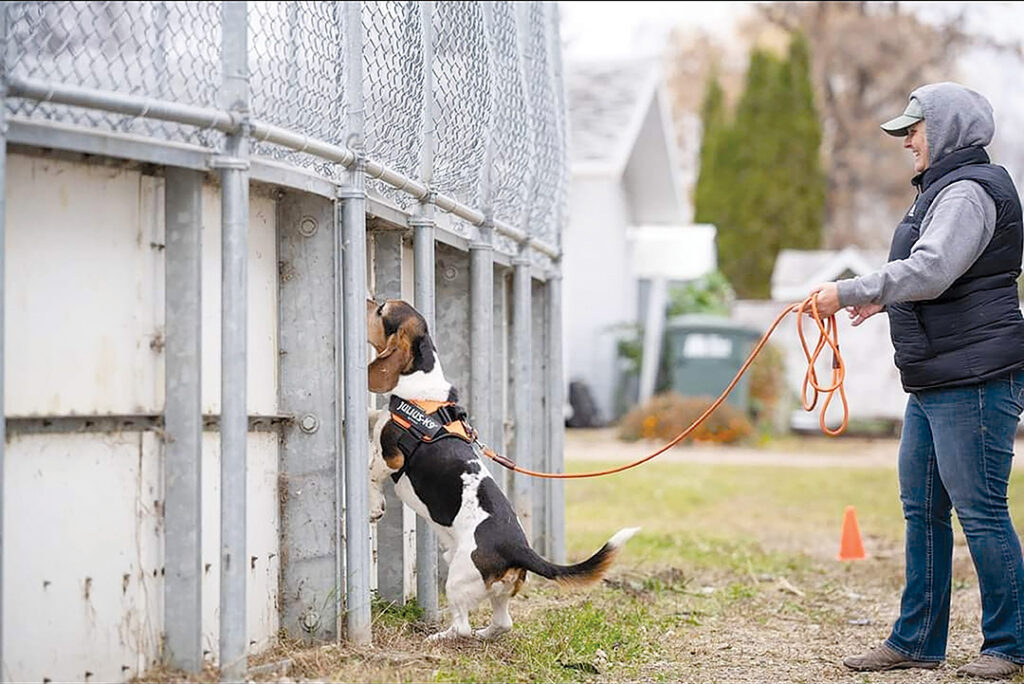
Leashes made of biothane, rope or nylon are the most popular and easiest to manipulate. The ideal length of a leash for scent work is 10-12ft for most dogs. This will allow the dog to move away from the handler to the far end of the leash and give the handler a full view of the dog when it is working the odour. Typically, the handler should try to stay behind the dog or parallel to the dog when possible. Of course that can change when you are in a tight space or have to move around obstacles like a desk with a chair.
Perfecting leash handling for scent work should start without a dog on the end of the leash. Getting comfortable with the leash by collecting and releasing it is a good place to start. But how do you practice without a dog? Attach the leash to a stationary object like a chair. To begin, get a feel for your leash by moving toward and away from the object and practice collecting and releasing your leash so it doesn’t tangle, tighten or touch the ground. You can add the dog later!
ROLE-PLAY
A fun exercise in leash handling is to attach the leash to another handler and have them act as the “dog”! The “dog” will make their way around a room with a variety of objects in it. The “dog” role will speed up, slow down, and make sharp and tight turns to mimic a dog searching for odour. This exercise is valuable to both ends of the leash. The handler end of the leash will get comfortable manipulating a leash and the “dog” role has a chance to feel what it is like to be restricted by poor leash handling. You will soon see how important it is for the two ends of the leash to work together and operate as one unit.
THE HANDLER
There are many things we train our dogs to do in scent work and often we forget that we are the other half of a team that also needs training. The onus is on us, the handlers, to train ourselves to manipulate a leash correctly. Leash handling is an art. It is a dance between the dog and the handler. It is a beautiful thing when the dog doesn’t even realize it is attached to a leash but is 100% connected to their handler through that seemingly non-existent leash.
Spend time on your leash handling skills to be the best partner for your dog because your dog is absolutely trying to be the best partner for you every time you step up to the start line.


