
SCENT 101
A lot of brain power goes into how a dog interprets all the smells in the world around them.
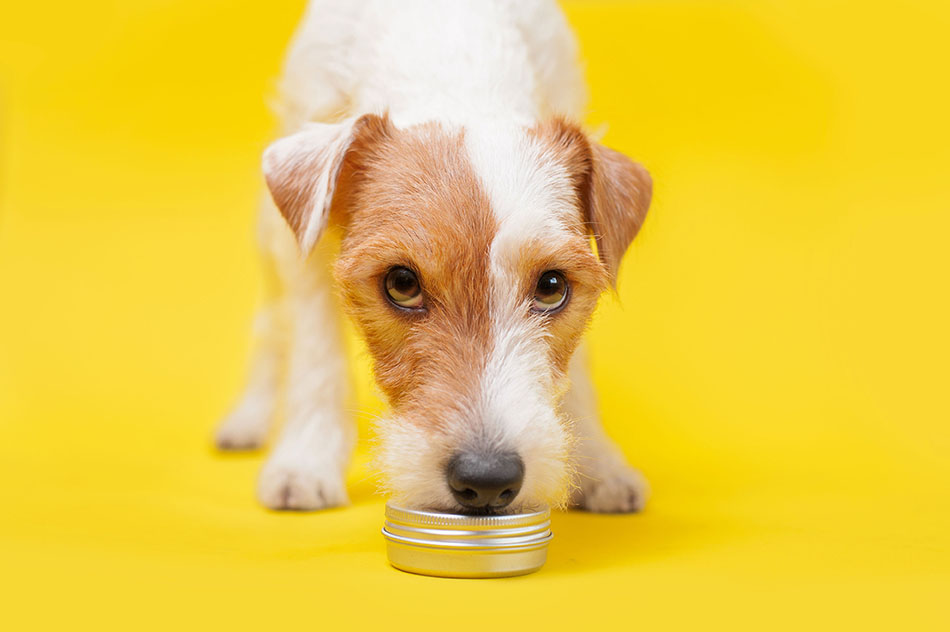
A dog has more than 100 million sensory receptors in the nose, even higher in some dog breeds, compared to around 5 million in humans, and it is estimated about a third of the dog’s brain is dedicated to interpreting and analyzing odour, about 40 times greater than humans.
There is no wonder why dogs are so good at scent sports. Dogs use sniffing as a coping mechanism. It helps them focus, navigate their environment, satisfy their hunting instincts, burn mental energy, and relieve stress. Sniffing and searching are great ways to build confidence in your dog too.
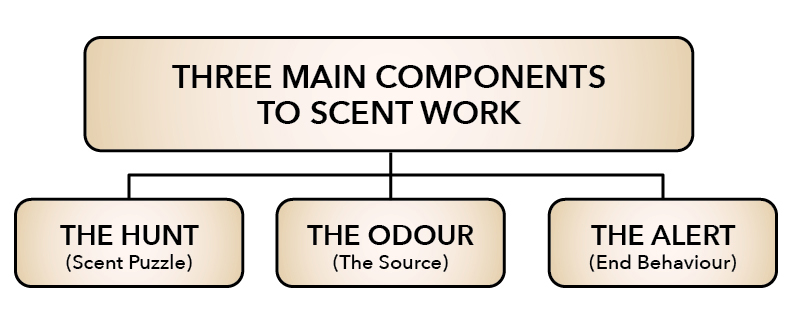
THE HUNT
For a lot of dogs the thrill of the hunt is enough to get them going, especially if they know what they are looking for. Prior to introducing odour or objects, you can play food scatter games or hide treats to start reinforcing the hunting instincts. This will build on problem solving skills to figure out the puzzle to the reward, and to search independently.
The movement of odour is referred to as a puzzle. Air flow is required to create the puzzle for our dogs to hunt, that only they can detect. There are many factors that affect the puzzle and how the odour circulates. Hot environments make the odour stronger, and be more distributed, where cold environments sink the odour covering a smaller area, the odour is more contained. This will effect how detailed a dog will need to search to pinpoint the source.
Air flow plays a large role in the search. When air particles are disturbed by flowing into objects, fans, windows, doors, etc. the odour will move differently. One way you can look at air flow is to relate it to water. When water moves over small and smooth objects it flows freely around them with little disturbance. When water hits a hard larger surface, the water will splash in all different directions, up, over, out, and back down. Think of air in the same way but moving slower.
THE ODOUR
The odour can be anything from essential oils like wintergreen, pine and thyme (SDDA – Sporting Detection Dogs Association), the scent of an article, human, critter, a toy, or anything you would like to train your dog to search for.
Objects can hold odour in different ways too. A plush toy, fabric, or something porous will hold more scent than something with a harder or smooth surface like glass, metal or plastic. Whatever you practice with, change the objects you use often. Your dog may end up relying on sight and choose the familiar object rather than using their nose to search for the odour. Keep the odour separate and in an air tight container, (if not a living thing,) to avoid contamination, especially essential oils. The oils can easily contaminate an entire room if forgotten about.
THE ALERT
The end behaviour is “The Alert”. Alerts can be very subtle, or very obvious. As a beginner you will need to look for subtle changes in body language like slowing down as they get closer to the source, or wagging their tail faster. You can reinforce natural alert behaviours like bumping their nose to the source and looking back at you. Some dogs will naturally offer a paw, sit, or a down when they have found something. You can build on what comes naturally, or train more obvious behaviours like a freeze once they have pinpointed where the source of the odour is.
Whatever you choose to do, nosework to search for scents, barn hunt to search for critters, scent hurdles or search and rescue to search out human scent or articles – these are good foundations to start with and you can tailor them to your chosen sport.


